


Consensus Lab (consensuslab.ai) is a free website that makes it easy for anyone to get answers about human health, nutrition and medicine. We collect the claims, and evaluate the evidence to estimate the ‘scientific consensus’. We cite our sources and weigh the quality of the evidence.
Why we built ConsensusLab
I want the same things most people want. To be healthy. To eat well. To be around, and useful, for a long time.
The problem is that believing in science and being able to use it are two very different things.
Here’s what actually happens when I try. I get curious about something ordinary: seed oils, say, or whether my morning coffee is helping or hurting, or how much protein is “enough,” or whether a late dinner matters. I go looking. Within about ten minutes I have found a credentialed expert who tells me the thing is fine, and another, equally credentialed, who tells me it is quietly killing me. Both cite studies. Both sound reasonable. Both have a book, a podcast, or a supplement line. And I am left exactly where I started, except now slightly more anxious.
For a while I assumed this was my failing: that if I were smarter or better trained I could just tell who was right. I’ve since decided that’s mostly not true, and it’s worth saying why.
Why is health and nutrition so hard?
It would be easier if the confusion were all grift. Some of it is. But many honest, well-meaning, experts in nutrition and medicine still can’t reliably give you the straight answer, and the reasons are structural, not personal.
There are more papers than any human can read. A specialist who does nothing but study dietary fat is looking at a firehose that never shuts off, at one section of a river. Single studies get enormous attention: a single striking result makes headlines, gets a segment, launches a diet, when a single study is precisely the thing you should trust least. The studies that find nothing often don’t get published at all, which quietly tilts the whole record toward “it works.” And people have cognitive biases, or a pet theory they’re attached to, or a reputation built on a prior position, and frequently a product downstream of the conclusion.
So you end up with smart people, arguing in good faith, reaching opposite conclusions from the same literature, because no one is actually holding the whole balance of evidence in their head at once. Nobody can. That’s the real problem. Not a shortage of information. A shortage of anyone able to weigh all of it, fairly, and keep the score updated.
That’s the thing I wanted to fix. ConsensusLab is what came out of it.
The idea underneath it
The insight I built on isn’t mine. It comes from recent computer-science research on how AI systems should organize scientific knowledge. In particular, a 2026 paper from Agents-K1: Towards Agent-native Knowledge Orchestration. Its argument, boiled down: most systems flatten a scientific paper into its abstract and a citation count, and in doing so throw away the very things reasoning actually needs. The specific claims a paper makes, the evidence behind them, and whether a later study is extending, merely using, or outright challenging that claim. The bottleneck for careful reasoning usually isn’t finding information; search is largely solved. It’s structuring it. Piling up documents and summarizing them doesn’t get you to truth. You have to break knowledge into small, verifiable pieces and track how the evidence bears on each one.
ConsensusLab takes that idea and aims it at a single question: what does the balance of evidence actually say about staying healthy? So it’s built as a graded map, not a pile of summaries.
Every health question becomes a single, specific claim: a subject, a relationship, an object. “Beta-glucan lowers LDL cholesterol.” “Time-restricted eating improves blood sugar.” Each claim then carries a ledger: every study we can find that bears on it, marked as supporting it, contradicting it, or testing it and finding nothing. Those studies are not counted equally. A large meta-analysis pooling thousands of people counts for far more than one mouse experiment. We deliberately keep the studies that disagree, because the disagreement is information, and hiding it is how you manufacture false certainty. Out of that ledger we compute one honest verdict for each claim, from “strong support” through “contested” to “refuted,” and you can click straight down from the verdict to the actual papers underneath it.
Why this is possible now, and not five years ago
None of this would have been doable by hand at any real scale, and it wouldn’t have been doable by AI until very recently either. Two things had to arrive.
The first is reach into the actual scientific record: a suite of specialized science tools from Google DeepMind that can query the biomedical literature, clinical-trial registries, and genetic databases directly. The second is a model careful enough to read those sources and reason about them. We pair those tools with Anthropic’s most capable reasoning models as of July 2026. Opus 4.8 and Fable 5: the tools go and fetch the evidence, and the models do the patient, unglamorous work of reading it and grading it the same way every time.
The AI is very good at reading ten thousand papers without getting bored, tired, or partial. It is not an oracle. Which is exactly why the whole system is built to show its work instead of asking you to take its word.
How the site is laid out
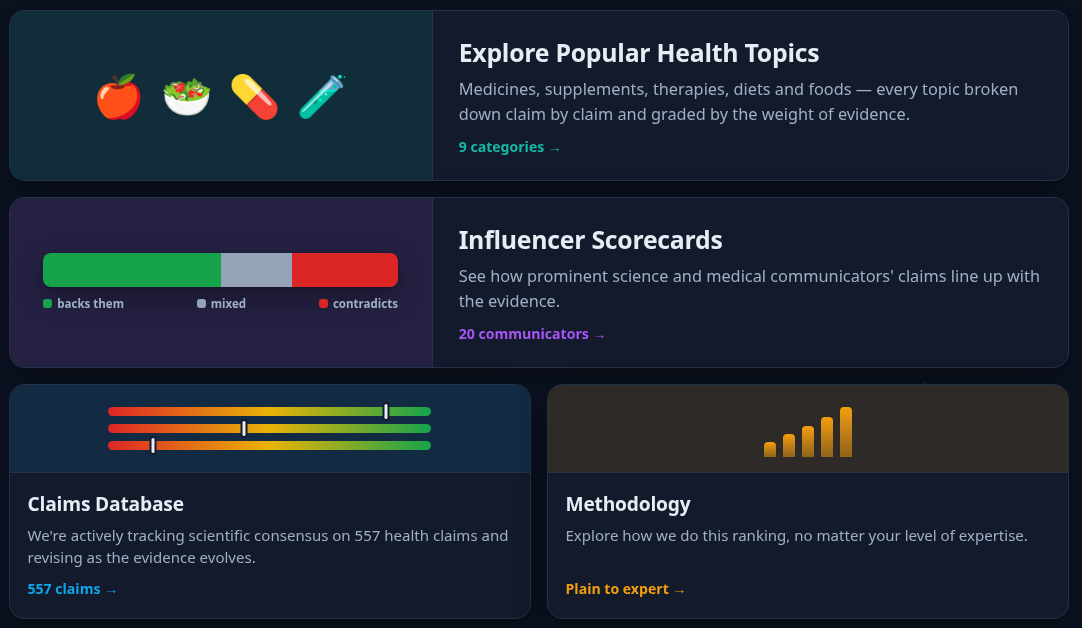
Health Topics lets you explore diets, medications, supplements, nutrition, foods, fitness, longevity and more. Pick a topic and you get the specific claims under it, each written as a plain question with a verdict you can drill into and every source used to calculate the grade. Disagree? We have a form where you can submit new studies to be including in the grading or flag the grading of existing ones.
Influencer Scorecards takes the claims popular health communicators make and grade each one against the independent evidence. We grade the claim, not the person. We focus on research scientists and medical doctors, but will include other vocal influencers in the health space. Some of them hold up remarkably well. Some don’t. The point is not to dunk on anyone; it’s to let you see, claim by claim, where a given voice is tracking the science and where they’ve gotten ahead of it.
What this free newsletter is for
Science isn’t static. We’ll be grading new claims, adding new influencer scorecards and changing our ratings when the evidence moves. We’ll concentrate on the science behind the issues that affect the most people.
We are not going to get everything right. Nobody can, and anyone who promises otherwise is selling something. What we can promise is the process: we’ll show our work, we’ll keep the studies that disagree with us, we’ll tell you plainly when the evidence is thin, and we’ll change our minds in public when the science does. These are powerful tools, and we intend to use them carefully and responsibly, which mostly means never pretending to be more certain than the evidence allows.
We’re not here to sell you a supplement or a miracle. We’re here because we wanted an honest map of what we actually know about staying healthy, couldn’t find one, and decided to build it. You’re welcome to use it too.
Please visit consensuslab.ai and let us know what you think!
–Studio Schade